Royal Caldelian Silver Jubilee

Royal Caldelian Silver Jubilee
Glorious Things of thee are Spoken

Friday, December 23, 2022

God rest ye Merry Gentlemen

 God Rest You Merry Gentlemen" is a traditional English Christmas carol. It is also known as "Tidings of Comfort and Joy", the phrase that ends each stanza of the lyrics. This carol is an affirmation of the birth and salvation in Christ, recounting His nativity event and the love of God.

The hymn is one of the oldest known Christmas carols.

Over the centuries, times and meanings have changed.  The song we sing today does not have the same meaning that it did to the English peasants in the 15th Century.

In the 15th Century church, songs of joy and happiness were allowed.  The songs were somber and usually written in Latin.

The people counteracted this by singing Christmas songs in the streets.  The nightwatchmen are said to sing God Rest Ye Merry, Gentlemen as they walked the streets of London.

In the Middle Ages the word “merry” meant great and mighty.  The word “rest” meant keep or make at this time.  So, the nightmen were really saying, “God make you mighty, gentlemen.”

Think back through history, and how England was known as “Merry old England” at the time this song originated.

Soldiers were told to eat and drink because tomorrow they would conquer hence the term “eat, drink and be merry”.

Ace Collins wrote ““God Rest Ye Merry Gentlemen’s” lyrics reveal that the song’s unknown writer knew the story of Jesus’ birth well. He included the high points of the gospel throughout the carol’s verses. The writer also fully understood the power of Christ and what His arrival meant to all who embraced it.”

While the song is believed to originate back to the 15th Century, evidence is lacking.  The first broadsheet of the song was published around 1760 in London.

Charles Dickens referenced the song in his classic A Christmas Carol.  “… at the first sound of ‘God bless you, merry gentlemen! May nothing you dismay!’, Scrooge seized the ruler with such energy of action that the singer fled in terror, leaving the keyhole to the fog and even more congenial frost.”

Wikipedia says the song is a Roud Folk Song and part of the Roxburghe Collection.


God Rest Ye Merry, Gentlemen has been a traditional Christmas carol since the mid-18th Century.  This may be due to Queen Victoria’s love for carols, which found their way into the Anglican Church and soon spread to America and Europe.  The upbeat melody also helped to keep the popularity of the song alive.

So, God keep you mighty, Gentlemen!


Sunday, December 18, 2022

It Came Upon a Midnight Clear” The story behind the Carol


Choir of Kings College 


 The Christmas carol, It Came Upon a Midnight Clear, is one of the very few that doesn’t actually mention the birth of the Savior. The life of the author will help us see why the message of the angels is more the focus of this beloved carol. 

Edmund Sears, a pastor in Wayland, Massachusetts, wrote the poem in 1849 after suffering a breakdown. Sears was experiencing a time of sadness with the revolution in Europe and the war with Mexico in the U.S., he saw everything around him as full of “sin and strife”.  The hymn below was printed in the Christian Register, a Boston paper published on December 29, 1849. The third stanza, which we rarely see, shows how worried Edmund Sears was about the world situation. 

“But with the woes of sin and strife

The world has suffered long;

Beneath the angel-strain have rolled

Two thousand years of wrong;

And man, at war with man, hears not

The love-song, which they bring:

O hush the noise, ye men of strife,

And hear the angels sing!”

Surely Edmund Sears would be worried about the state of affairs in the world today! This past year of 2022 has brought us so much uncertainty that when November rolled around, (or even before!) many were already decorating their homes for Christmas! People would post on social media pictures of their Christmas trees and lights and say, “Why not!” 

We are also facing (about to use my least favorite and overused word of the last couple of years) unprecedented and perilous times. It seems anything goes when it comes to finding a reason to celebrate or bring life to a dark world. 

This season of Christmas, full of hope, reminds us all of the Savior that was born so long ago. He didn’t stay in the manger, but gave His very life for YOU and me and one day soon we will reign with Him and the “whole world give back the song which now the angels sing”. 

There was much to be hopeful for then, the angels were bringing a message of good cheer! Be prayerful and ask God to put someone in your path to share this Good News: There is much to be hopeful for NOW…Jesus Christ is about to return for His Bride, the Church. For lo, the days are hastening on!


 It came upon the midnight clear,
    That glorious song of old,
From angels bending near the earth
    To touch their harps of gold;
“Peace on the earth, good will to men
    From heaven’s all-gracious King” –
The world in solemn stillness lay
    To hear the angels sing.

2. Still through the cloven skies they come
    With peaceful wings unfurled,
And still their heavenly music floats
    O’er all the weary world;
Above its sad and lowly plains
    They bend on hovering wing,
And ever o’er its Babel-sounds
    The blessed angels sing.

3. But with the woes of sin and strife
    The world has suffered long;
Beneath the angel-strain have rolled
    Two thousand years of wrong;
And man, at war with man, hears not
    The love song which they bring; –
O hush the noise, ye men of strife,
    And hear the angels sing!

4. And ye, beneath life’s crushing load,
    Whose forms are bending low,
Who toil along the climbing way
    With painful steps and slow,
Look now! for glad and golden hours
    Come swiftly on the wing; –
Oh, rest beside the weary road
    And hear the angels sing!

5. For lo! the days are hastening on
    By prophet bards foretold,
When, with the ever circling years
    Shall come the age of gold;
When Peace shall over all the earth,
    Its ancient splendors fling,
And the whole world give back the song,
    Which now the angels sing.


May you find peace in Jesus even though the world around us is in crazy chaos. Rest beside the weary road and hear the angels sing.


Source : Hopeinthehealing.com

Saturday, December 17, 2022

What Child Is This , Christmas Carol


“What Child Is This?” is a famous and traditional Christmas carol crafted in 1865. The lyrics were composed by William Chatterton Dix, the son of a surgeon residing in Bristol, England. William spent most of his life as a businessman in Glasgow, Scotland, working at the managerial level of the Maritime Insurance Company. He was greatly enticed by traditional English folk songs. And when he started writing the lyrics for “What Child Is This?,” he decided to utilize the melody of “Greensleeves” to create the carol. It is his most memorable and famous creation to date.

Jesus Christ's birth & 3 wise men

Origin

In 1865, William was 29 years old when he suffered from a near-fatal bout of sickness. He was afflicted with severe depression, and this near-death experience changed him completely. While undergoing recovery, he experienced a spiritual awakening that inspired him to start crafting hymns. He became an avid reader of the Bible, subsequently wrote the lyrics of “What Child Is This?,” and incorporated the tune of the celebrated English folk song, “Greensleeves.”

Greensleeves was already one of the most aesthetic and beloved melodies of the festive season at that time. Although it’s not a quintessential Christmas tune, its association with the festive season can be dated back to 1642. It was paired back then with Waits’ carol titled, “The Old Year Now Away is Fled.” Also, William Shakespeare refers to this popular tune twice in his famous play - “Merry Wives of Windsor.” 

William Chatterton Dix

His affiliation with the church is vivid through his hymns, which were subsequently published in “A Vision of All Saints,” “Verses on the Holy Eucharist,” and “Altar Songs.” Around Christmas of 1865, he also crafted the poem titled “The Manger Throne.” Then, he crafted other popular hymns like “As With Gladness Men of Old” and “Alleluia! Sing to Jesus!” According to expert hymnologists, Dix’s hymns are imaginative, reverent, and simple, yet borderline sentimental. They have always proved to be considerably sincere to their roots. 

Analysis 

The lyrics were inspired by one of William’s verses titled “The Manger Throne.” It urges humanity to accept Christ. The eloquent melody is haunting, and its beautiful essence reiterates the “Adoration of the Shepherds” who paid a visit to Jesus during the nativity. The lyrics pose questions that reflect what the shepherds might be pondering about during the encounter and subsequently offers a response to such questions. 

The first stanza is heavily influenced by his contemporary romantic poets and flirts ceremoniously along the edges of emotionalism. The carol starts with a rhetorical question, condensing the concept of childbirth within a single paragraph. The poet has successfully painted a classic picture of the nativity - the child Christ sleeping on mother Mary’s lap, as the angels and shepherds provide the background score with “Anthems Sweet” and “Watch and Keep” respectively.       

The second stanza offers a momentary reference to “mean estate,” or less than an ideal condition. The poet registers similarity with the first stanza with another rhetorical question. He wonders why the child Christ should be displayed in such a humble environment. The poet tries to decipher the answer analytically,  and reasons that the “mean estate” that refers to the birth of Christ has its roots entangled with his future sufferings. The second stanza alludes to the anguish and distress of Christ's future.     

The poet utilizes the final stanza to expand the emphasis on the people attending the humble scene. He draws inspiration from the Epiphany season and focuses on the metaphorical gifts that are being bought for the infant. His setting flouts the conventional structure of time quite comprehensively, like everyone, starting from the “king” or the “peasant” is offered an equal chance. 

Usage in Popular Culture

“What Child Is This?” was first published in 1871, six years after its origin. It was featured in an influential and prestigious collection of carols in the United Kingdom, titled “Christmas Carols Old and New.” The hymnal was edited by John Stainer and Henry Ramsden Bramley. Stainer was primarily responsible for harmonizing the musical setting. In recent times, the carol has gained quite some popularity in the USA, in spite of its roots being in Great Britain. 

Conclusion

The meaningful lyrics and the soulful melody of the carol evokes a palpable scenario. It gives the feeling that God himself has transformed into the form of man through this baby, and that the Almighty has arrived to rescue humanity. It's a certain and clear sign, which the humans went on to declare with courage and ingenuity. The tribute is fitting, as humans marvel and wonder in amazement the true sense of inevitability, "What child is this?"


Monday, December 12, 2022

Angels We Have Heard on High


"Angels we have heard on high” is a song of invitation from Christians to others to come celebrate Christ’s birth with them. The carol begins in a festive spirit, but then, in the second stanza, asks why there is a celebration.  In the third stanza, an invitation to is given to join the celebration.  The fourth stanza concludes the carol with the observation of Christ’s birth and the Christian’s joyful response.
Angels We Have Heard on High commemorates the birth of Jesus Christ found in the Gospel of Luke.  The song focuses on the shepherds encounter with the angels foretelling of the birth of the newborn child.

3126294889_71a3525df1_b

Reports say that in 129 A.D. Pope Telesphorus ordained that the “Gloria” be sung at the Christmas Eve midnight mass.  The phrase became known as the “Angels Hymn” and considered one of the earliest known Christmas hymns.
The “Gloria” is believed to have inspired the chorus in Angels We Have Heard on High.  The tune is believe to be inspired by an unknown tune that was arranged by Edward Shippen Barnes in the early 1900s. 
French legend indicates that in medieval times on Christmas Eve, the shepherds would sing and call to one another from one hillside to another.  

“They would call “Gloria in excelsis Deo” which means “glory to God in the highest” in Latin. It was how they would spread their holiday message and cheer from points far away to one another. From hillside to valley, the shepherd’s song must have truly sounded like angels calling to one another in celebration of the birth of Christ for the Christians living in nearby regions. Also, the song reflects the shepherd’s joy that the time of the holiday season has arrived yet again.”

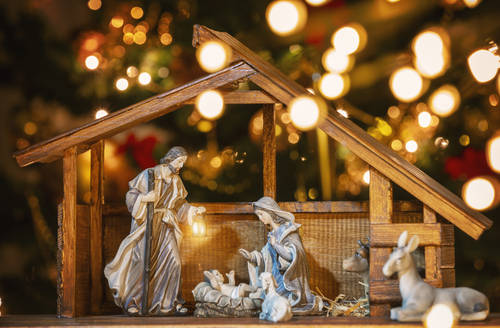
“Angels we have heard on high” is a perfect song to accompany the French tradition of the crèche. Handmade nativity scenes are not only common in homes, but also in town squares. Little clay figures, traditionally made in the south of France, are called “santons” (“little saints”).  Fine craftsmanship characterizes the production of these figures, and they are a source of local pride for the communities that produce them. It is interesting that “crèche” is also the French term for a nursery for young children during the day.

French crèche

This tradition is particularly strong in Provence, the south of France, with a crèche that includes the Holy Family, the Magi, the shepherds, and the animals, along with additional local figures, such as the mayor, the little drummer boy, or a peasant dressed in traditional attire. In some villages, people dress as the shepherds and join in a procession to the church. Children often contribute to domestic crèches by bringing small stones, moss, and evergreens to complete the scene. Then everyone sings carols!


The tune has also undergone some changes. Austin C. Lovelace harmonized the French carol in 1964. The 1935 Methodist Hymnal uses an earlier harmonization, which is anonymous.  Technically, this is a macaronic carol because it uses two languages: the local vernacular and Latin. The carol uses the effect of a refrain and is one of the few texts that congregations sing regularly in Latin: “Gloria in excelsis Deo!”  It is unusual for congregations to sing a long melisma (many notes on one syllable) and enjoy it.  The melisma on the refrain adds to the joyful, celebratory feel of the entire hymn. 

Sunday, December 11, 2022

Enduring Christmas melody ‘Away in a Manger’ is a staple of carol services and nativity plays


But what are the lyrics, who composed it and why are there two melodies?

‘Away in a Manger’ is a beloved Christmas carol, first published in the late 19th century. Here’s all you need to know about its composer, lyrics, and two famous melodies.


Who composed ‘Away in a Manger’?

The origins of this festive favourite haven’t always been clear.

Until the 20th century, ‘Away in a Manger’ was known as ‘Luther’s Cradle Song’, as it was believed the Christmas carol was composed by Martin Luther, a German priest. Historians have since debunked this theory, as none of Luther’s writings mention the song, and no German text for the carol has been found from earlier than 1934.

It’s now believed the carol originated in the US, in the Evangelical Lutheran Sunday School’s 1885 collection Little Children’s Book for Schools and Families.

According to the Hymnology Archive, the song was likely written for Martin Luther’s birth and later, misleadingly attributed to Luther himself, “even though this song is not to be found in any of Luther’s hymn collections, nor it is known to have existed in any form in the German language”.


What are the lyrics to ‘Away in a Manger’?
What are the lyrics to ‘Away in a Manger’? Picture: Getty

Why are there two versions of ‘Away in a Manger’?

‘Away in a Manger’ has two famous musical settings – one more popular in the US, the other better known in the UK and Ireland.

The melody best known in Blighty, known as ‘Cradle Song’, is thought to have originally been composed by Jonathan Spilman in 1837, before being adapted in 1895 by William Kirkpatrick.

‘Mueller’ is the melody best known in the US. First published under the title ‘Luther’s Cradle Hymn’, it was penned by James Murray and first published in 1887’s Dainty Songs for Little Lads and Lasses. It sounds like this:

What are the lyrics to ‘Away in a Manger’?

Away in a manger, no crib for a bed,
The little lord Jesus laid down his sweet head.
The stars in the bright sky looked down where he lay,
The little lord Jesus asleep on the hay.

The cattle are lowing, the baby awakes,
But little lord Jesus no crying he makes.
I love thee, lord Jesus! Look down from the sky,
And stay by my bedside till morning is nigh.

Be near me, lord Jesus; I ask thee to stay
Close by me for ever and love me, I pray.
Bless all the dear children in thy tender care,
And fit us for heaven to live with thee there.


Source : Classic Fm

Monday, August 29, 2022

The 1685 Coronation Anthem "I was Glad"

Choral splendour and huge organ chords, Parry's anthem was the first piece to be played as the coronation service started in 1953. Settings of the text, Psalm 122, have been used throughout British history at coronations, including a setting by Purcell in 1685.


Sir Hubert Parry (1848-1918) composed this setting of verses from Psalm 122 for the Coronation of King Edward VII in 1902, revising it for George V’s Coronation in 1911 by adding a more impressive introduction. Settings of the text by Purcell, John Blow and other musicians had been sung at previous Coronations, but it is Parry’s revised anthem that has been used subsequently, as well as being performed on State occasions and at royal weddings. 


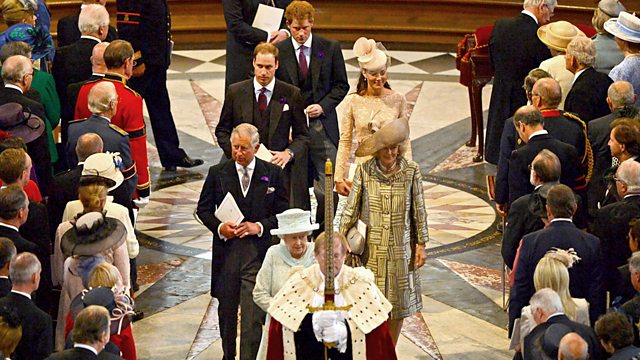
At the Coronation of Queen Elizabeth II on 2 June 1953, the anthem was sung as the Queen entered at the west door of Westminster Abbey and processed into the Church. 


Despite his father’s opinion that music was not a suitable career for a gentleman, Hubert’s musical talent was nurtured at his prep school and while still at Eton he became the youngest student to gain a BMus from Oxford. He read law and modern history at Oxford, but kept up his musical studies while working in insurance until his compositions came to public notice. Having been employed by George Grove of the great new Dictionary of Music and Musicians, he was eventually appointed to the staff of the new Royal College of Music. When Grove retired as director of the RCM, Parry succeeded him and held the post until his death.


The full choir begins the anthem, then divides into two at the words ‘Jerusalem is builded’. The central section, a contemplative prayer for the peace of Jerusalem, is sung by the semi-chorus before the whole choir re-combines and the music builds to its final climax. 


I was glad when they said unto me,
We will go into the house of the Lord.
Our feet shall stand in thy gates, O Jerusalem
Jerusalem is builded as a city that is at unity in itself. 

O pray for the peace of Jerusalem, they shall prosper that love thee.
Peace be within thy walls, and plenteousness within thy palaces.


Book of Common Prayer, 1662, Psalm 122, vv 1-3, 6, 7

Wednesday, August 17, 2022

What Is the Story Behind Mendelssohn’s Wedding March?

Have you ever sat waiting for the bride to walk down the aisle, ears straining for the first bars of “Here Comes the Bride” or the “Wedding March,” and wondered how long the tradition of playing these songs has been around?


There are many superstitious wedding traditions, but some have pretty clear origins.

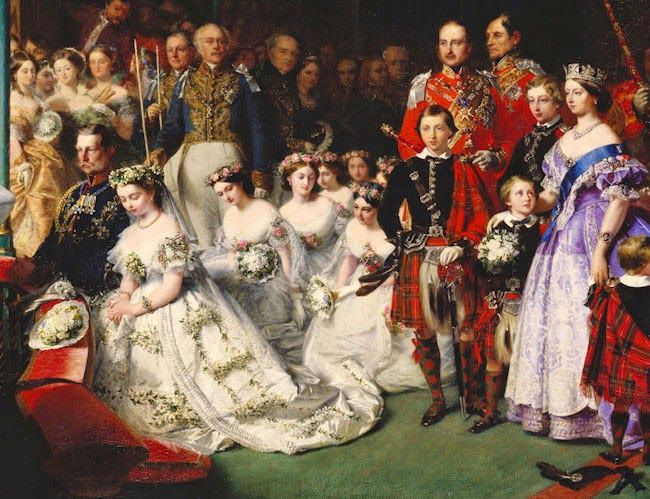
One of those is the music most commonly associated with Western weddings. The “Wedding March” and the song perhaps best known as “Here Comes the Bride” are both believed to have been first performed at a wedding that took place 160 years ago , when Princess Victoria Adelaide Mary Louise, Queen Victoria‘s oldest child, married Frederick William IV of Prussia on Jan. 25, 1858, in the Chapel Royal at St. James’ Palace.

But neither song was actually composed to be performed at a wedding. Rather, German composer Felix Mendelssohn wrote the “Wedding March” for an 1842 production of Shakespeare’s A Midsummer Night’s Dream,and “Here Comes the Bride” was the Bridal Chorus from Richard Wagner’s 1850 opera Lohengrin.

It was the 1858 royal wedding that is thought to have started the practice of a “full choral processional from the church entrance to the altar” and playing music as the bride walked up the aisle, “a change from the usual practice of having music only at the reception,” according to Elizabeth Hafkin Pleck’s Celebrating the Family: Ethnicity, Consumer Culture, and Family Rituals“A patron of opera who loved Mendelssohn and Wagner, the princess chose the music for her ceremony.”


Usually, the “Bridal Chorus” is played without singing at modern weddings, but you can see the original lyrics and learn more about some of the controversy surrounding it here.

The “Wedding March,” composed by Felix Mendelssohn, was created in 1842 to accompany Shakespeare’s famous A Midsummer Night’s Dream.

Mendelssohn’s wedding march was first played in a wedding in 1847, but it was Victoria, the Princess Royal and Queen Victoria’s daughter, who made it the song to play during a wedding ceremony by having it accompany her own wedding in 1858.


The traditional white wedding 

As still happens at many weddings today — though many couples now choose to branch out, for reasons both personal and political — the Wagner chorus was played as the Princess processed to the altar, and the Mendelssohn march was played as the newlywed couple recessed back up the aisle. Once the royal couple used that music in their ceremony, it caught on more widely.

Plus, starting Western wedding traditions clearly ran in the family: the Princess’ mother, Queen Victoria, was the one who popularized white wedding dresses.

ASTORIA GALLERY

Christmas Message

  Sunset on Venice Beach, California  Christmas Eve The Royal Caldelian Christmas Message  As we gather to celebrate this season of joy, we ...